Set Hard, Wear Soft: The Wet-Set Perm Rewriting Britain's Winter Curl Rules
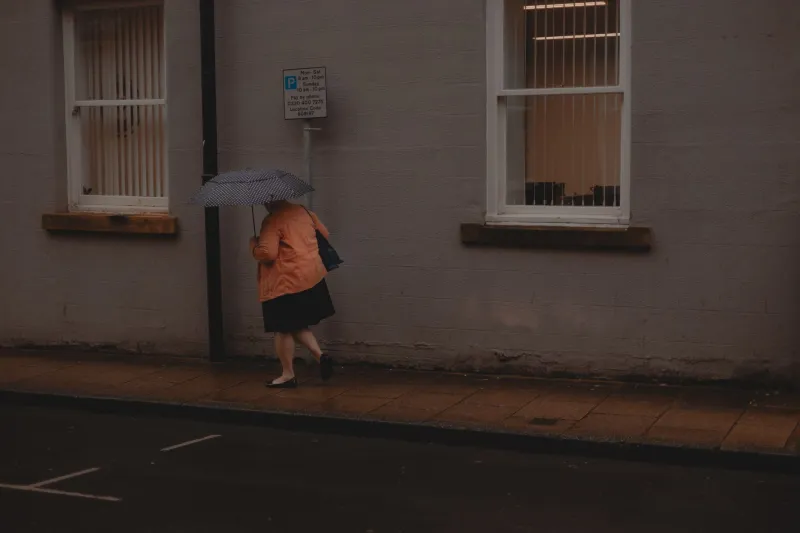
The bus shelter on a wet Tuesday in Leeds is not a salon. But it is where you notice the curl. A woman in a black parka shakes the rain off her hood, and her hair does not move like hair that has been rained on. It sits in tight, wet-looking rings, each one holding its shape like it has been set in place with a very small wrench. This is the perm as it is being sold in UK salons this winter: not soft, not nostalgic, not apologetic. Hard curl. Built to last.
The Curl That Came Back With a Wrench
The perm never really left. It went quiet, then experimental, then a bit ironic. But the version landing in British salons for winter 2026 is none of those things. It is a tight, wet-set pattern — smaller rods, firmer tension, a defined S-bend that reads as deliberate rather than accidental. Stylists in Manchester, Bristol and Glasgow describe the same request: something that holds through drizzle, hat hair and the walk from the club to the last bus.
This is not the Eighties perm your mum warned you about. There is no frizzy halo, no chemical smell hanging around for a week, no sense that the hair has been beaten into submission. The new hard curl is closer to sculpture. It is also, crucially, a street-style move. Paired with a blunt fringe, a shaved nape or a leather jacket, it looks less like a salon set and more like a decision.
Built Wet, Set Tight
The technique matters more than the label. A hard curl is wound wet, not damp. The hair is sectioned cleanly, and the rods are smaller than the ones used for a soft body wave — often 8mm to 10mm in the tightest areas, opening up slightly around the crown. Tension is firm but controlled. Too loose and the pattern drops; too tight and you get breakage at the root.
Processing time is watched like a kettle. The solution goes on, the clock starts, and the neutraliser does the curing. Stylists describe the result as a curl with a memory. It is not waterproof, but it is weather-literate. Rain might flatten the surface for a minute; the pattern underneath springs back once it dries. A wool hat will compress it, but the tightness means it bounces rather than collapses.
One curl specialist in Soho puts it simply: the pattern is decided at the rod, not at the diffuser. That is the difference between a hard curl and a hopeful one. If the winding is wrong, no amount of scrunching will save it.
Rain, Hats and the 1am Bus
British winter is a stress test for any hairstyle. Central heating, sudden downpours, scarf friction, the hood-up dash between pub and taxi. Soft waves surrender by 9pm. A tight wet-set curl has a better chance. It is not immune to humidity, but it has structure. The defined rings keep their shape even when the surface goes a bit fuzzy.
The hat issue is real, though. Anyone who wears a beanie from November to March knows the flat-top risk. A hard curl handles it better than looser textures because the pattern is denser. Take the hat off, give the roots a shake, and the curl re-forms. A light mist of water and leave-in conditioner speeds it up. It is not magic. It is engineering.
The Aftercare Reality
This is where the romance ends and the routine begins. A hard curl is not a wash-and-go situation. Dry brushing is out. Towel roughing is out. Hot tools on high are out. The curl wants water, moisture and a cast. Think sulfate-free shampoo, a curl cream, a gel or mousse, and a diffuser on low heat. Sleep on silk or wrap it in a scarf. Refresh in the morning with water and a little leave-in, not a full wash.
Salon visits land every eight to twelve weeks, depending on growth and how tight the original set was. Expect to pay £90 to £180 in regional cities and £150 to £250 in London, with higher prices in specialist curl salons. That is not a small commitment. But the people booking it are not looking for a low-maintenance wave. They want a silhouette that survives the week.
There are limits. Hair that has been heavily bleached, recently coloured or already fragile is not a good candidate. A perm on compromised hair is a chemistry experiment you do not want. Patch tests are non-negotiable. So is an honest conversation about length — a hard curl on very short hair reads more barbershop than bohème, which is fine if that is the aim.
Who Should Sit in the Chair
This cut is for the person who is bored of hair that needs re-styling by lunchtime. It suits dense hair, strong shapes and anyone who likes a bit of edge. It is less forgiving on fine hair unless the stylist adjusts rod size and processing time carefully. It is also a commitment to routine. If you cannot face a diffuser and a refresh spray, the hard curl will not be your friend.
But for the right client, the payoff is obvious. The curl looks intentional from across the street. It has a graphic quality that photographs well and a toughness that suits British winter better than any soft-focus wave. It is bold hair, salon-built, and street-ready — which is exactly where Concrete Hair likes to live.
The Street-Style Payoff
The best versions of this perm are not styled to look polite. They are worn with a straight-faced fringe, a clipped side, a dark gloss or a bit of grit at the roots. In London, stylists are pairing tight curls with shaved nape lines. In Glasgow, it is all about volume at the crown and a blunt edge around the face. In Bristol, the look is looser at the back, tighter at the front, like the hair has been caught mid-motion.
That is the point. A hard curl is not a costume. It is a texture that holds its shape through real weather and real nights out. It looks best when it has been slept on, rained on and shaken back into place. Soft hair has its place. But this winter, the boldest move is the curl that refuses to budge.